


GUJARAT 7 Nights/ 8 Days : 1N Ahmedabad – 1N Jamnagar – 1N Dwarka – 1N Somnath – 2N Sasangir – 1N Ahmedabad
Overview
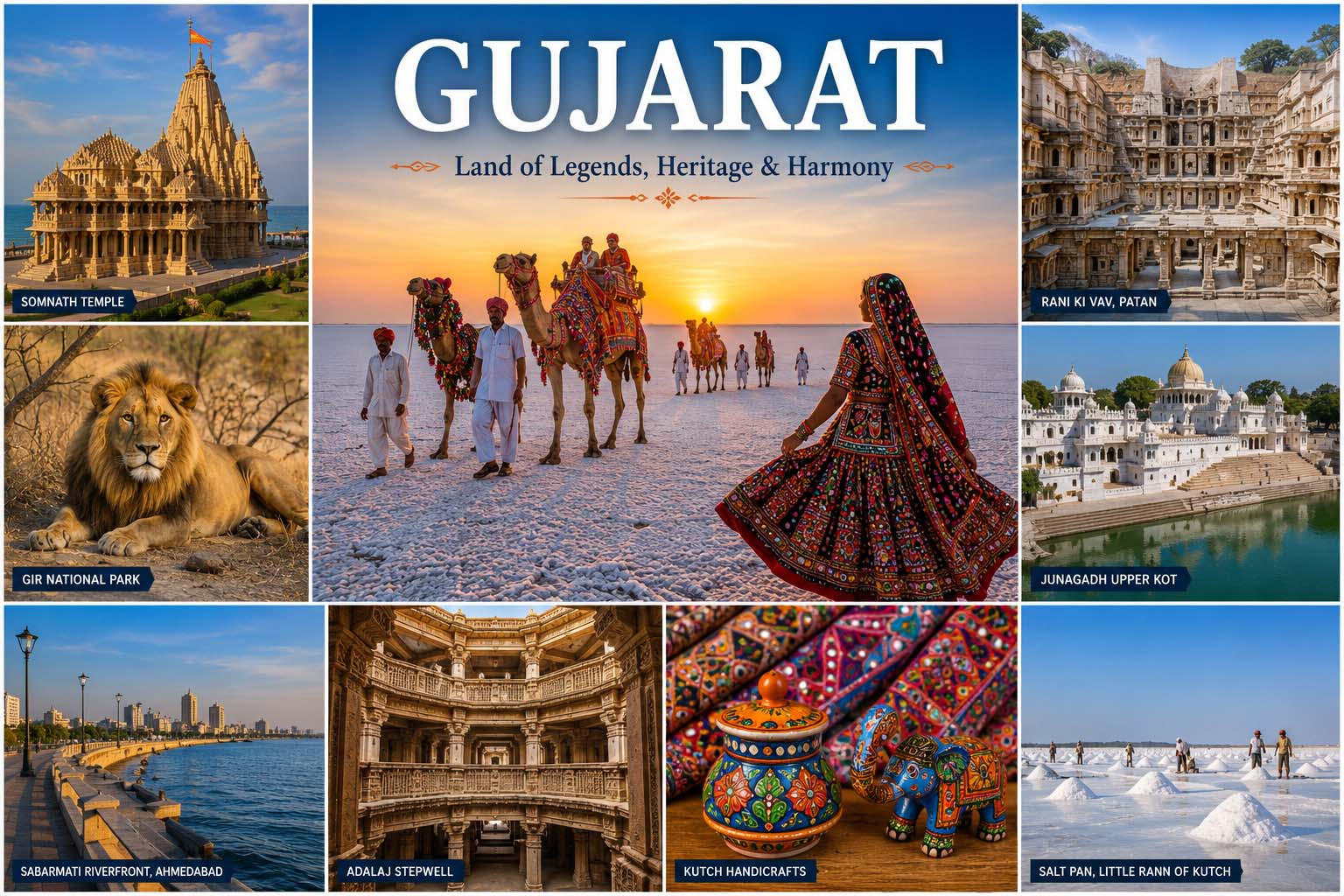
Explore the rich heritage, spirituality, and wildlife of Gujarat with Floater Holidays on this exciting 7 Nights / 8 Days tour covering Ahmedabad, Jamnagar, Dwarka, Somnath, and Gir National Park. Experience the divine atmosphere of ancient temples, witness the sacred coastal beauty of Dwarka and Somnath, explore vibrant local culture, and enjoy thrilling wildlife adventures in the home of the majestic Asiatic lions at Gir. From spiritual experiences to nature and history, this journey offers the perfect blend of devotion, relaxation, and unforgettable travel memories.
Included/Excluded
- MONUMENTS Entrance Fee
- Services of English-Speaking Local / Accompanying Guide in any of the cities.
- Jeep Safari at Gir National Park / Devalia Park in Sasangir is NOT INCLUDED.
- Park Entrance Fees of Gir National Park / Devalia Park in Sasangir is NOT INCLUDED.
- Anything which is not mentioned under “INCLUDES” header.
- Any meals apart from the ones mentioned above.
- All personal expenses, optional tours, and extra meals
- Expense of personal nature like tipping, laundry, telephone / fax calls, alcoholic beverages, camera/video camera fee at monuments, medical expenses, airport departure tax etc.
- International or Domestic airfare.
- Medical and travel insurance
- Cost incidental to any change in the itinerary/stay because of flight cancellation for any reason whatsoever and/or any factors beyond our control.
- Any expenses caused by reasons beyond our control such as roadblocks, accidents & any medical evacuations.
- Any train delays, or re-scheduling etc.
- Any Visa fees, insurance fees, etc.
- Any tips to hotel staff, local guides, drivers etc.
- Any expenses apart from the ones above.
- GST
- Airfare / Train tkt (if not mentioned specifically)
- Early check-In & late check-out at Hotel
- Camera fees, Entrance Fees, Safari fees, Tour Guide, Travel Insurance
- Water sports, Adventure sports activity
- Any expenses towards Beverages (alcoholic or non-alcoholic)/usage of mini bar/Tips/Telephone calls/Laundry/room service or anything consumed personally
- Any expenses caused by any unforeseen eventuality such as any natural calamity/landslides/road closure/political unrest/Flight or Ferry cancellation/ Flight or Ferry time change/ excess Baggage/Porterage on airport/hotels/railway station.
- Anything which is not included in the above itinerary/inclusions
Tour Amenities
Tour Plan
Arrive Ahmedabad and transfer to your hotel. Ahmedabad is Located on the banks of the river Sabarmati; the city was founded by Sultan Ahmad Shah in 1411. Today it is one of the fastest growing cities of India and is an immense repository of tradition, history & culture. Its famous walled area is one of the finest examples of community living & the city thrived as the textile capital & was nicknamed “Manchester of the East' in 1888. This multicultural city is home to some of the finest Indo-Sarcenic mosques & Jain temples.
The old city of Ahmedabad is dotted with labyrinthine by lanes called 'polls'. The exquisite carved wooden mansions and havelis are in no manner less than their stone counterparts in Rajasthan. The city also offers a rich architectural legacy that blends Hindu and Muslim schools of architecture, stone and brick with arches, domes and vaults, carved pillars, trefoil designs besides the modern buildings designed by the famous French architect, Le Corbusier and Louis Kahn.
Later proceed for city tour of Ahmedabad. Gandhi Ashram: On a quite peaceful stretch of the Sabarmati River, Mahatma Gandhi set up a simple retreat in 1915. This was his Satyagrah Ashram and for many years it was the nerve centre of India’s freedom movement. It was from here, in 1930, that Mahatma began his famous Dandi March to the sea to protest the Salt Tax imposed by the British. Hridaya Kunj, the simple cottage where he lived, is now a national monument and preserved as it was during the Mahatma’s lifetime.
Sidi Sayed Mosque: One part of the wall in the old citadel of the mosque built by Ahmed Shah’s slave, Sidi Sayed, is celebrated the world over for its exquisite stone window tracery – a superb & peerless example of delicate carving that transforms stone into filigree.
Hutheesingh Jain Temple: Built outside the Delhi Gate in 1850 by a rich Jain merchant, the Hutheesingh Temple is the best known of Ahmedabad’s many ornate Jain temples.
Adalaj Step-well: Adalaj is situated about 17 kms. north of Ahmedabad. The Baoli or step-well at Adalaj Vav is one of the finest steps well in India. Queen Rudabai built this well in 1499 to provide the traveller with a cool and pleasant refuge from the summer heat. A long flight of steps descends to the water. It has three entrances leading to a huge platform that rests on 16 pillars, with corners marked by shrines. Ornately carved pillars and cross beams create open spaces and four storey that are quite striking. The octagonal well is five floors deep. The Baoli is decorated with exquisite stone carvings, subjects ranging from eroticism to buttermilk.
Akshardham: Lord Swaminarayan, born in Chapaya in Uttar Pradesh, took a seven-year pilgrimage in Gujarat to preach his religion. He built six temples, the first being at Kalupur in Ahmedabad. Akshardham, the Swaminarayan temple of Gandhinagar, is a modern complex, built in traditional Indian architectural style from 6,000 metric tons of pink Rajasthan sandstone, carved by expert artisans from Bansipahadpur. The temple is set in a multi-acre garden called Sahajanand Van, with intricate sculptures of Hindu Gods. There is a gold-leaf copper sculpture of Lord Swaminarayan that faces similar sculptures of Gunatinand Swami. The interiors have beautiful columns in rosewood that rise to a high dome. Akshardham remains closed on Mondays.
Evening Market at Law Garden displays beautiful textile handicrafts of Gujarat.
Overnight at hotel
After breakfast arrive Jamnagar and transfer to your hotel.
Jamnagar or the city of Jams was one of the most important princely states of Saurashtra. Today, the 200km long Jamnagar coast is dotted with several industries run by corporate giants in the region. Jamnagar itself is a centre for the brass industry, bandhani fabrics and zari work.
Bala Hanuman Temple: Bala Hanuman Temple is a pilgrim place venerated by the devotees of Lord Rama. It is a world-famous temple, known for the continuous chanting of Jai Ram, Shri Ram. The chanting is going on since 1964 and has found a place for it in the Guinness Book of World Records. People chant the name of the Lord in shifts, 24hours a day
Lakhota lake or Ranmal Lake: Ranmal Lake was constructed in the mid-19th century by Jam Ranmal II, the king of Nawanagar. The lake was intended to act as a water reservoir in times of need. It is a major place of recreation for the people of Jamnagar who wants to spend some quality time with family and friends amidst nature. It is an ideal place for bird watching, especially during the winter season. Ranmal Lake itself is a scenic breath of fresh air in the hustle of the city.
Overnight at hotel
After breakfast drive to Dwarka, arrive Dwarka and transfer to your hotel.
The small coastal town of Dwarka is one of the four most holy Hindu pilgrimage sites in India. It is here that Krishna founded his capital after leaving Mathura. Excavations have revealed 5 earlier cities at the site, all submerged. The present town dates largely to the 19th century and attracts thousands of pilgrims to celebrate the Holi, Diwali and Janmashthami festivals. The multi pillared Sabha Mandapa leads to a 60-pillared sanctum sanctorum that dates back 2500 years as per the scriptures.
Gomti Ghat – A significant tributary of the river Ganges, the Gomti River is the most revered waterbody in the Hindu faith. The mouth of the Gomti river sites the Gomti Ghat, which requires about 56 stairs to reach from the Dwarkadhish Temple. The serene ghat location is great for some photo ops. Besides, it also makes for a pilgrimage too, as many devotees take a sacred dip in the salty waters of the Gomti river.
Dwarkadhish Temple – Dwarka is known all over the world for the Dwarkadhish temple, the 'Lord of Dwarka'. This temple is also known as the Jagat Mandir or the temple of the world. This temple was constructed over 1400 years ago and houses the image of Lord Krishna. This temple is one of the most famous pilgrimage places for the Hindus and attracts pilgrims from all over the world. This temple is magnificently built on the traditional lines and has five floors supported by 60 columns. The temple is profusely carved from the base to the pinnacle. The temple is built of sandstone. The interior is simple while the exterior is covered with elaborate carvings. Some of the major festivals of Janmashthami
The Rukmini temple, dating from 12 to 13 Century, was built in honour of Rani Rukmani, princess of Vidharba, which was to be married to Sishupala, but fled with Lord Krishna. This small temple, 1.5 km north of the city, is an architectural masterpiece. The temple walls are decorated with beautiful paintings and sculptures.
Bet Dwarka: Bet is situated at 30kms from Dwarka and is surrounded by sea from all sides. One can reach Bet from Dwarka through Okha by road. On reaching Okha port jetty, one can reach Bet through a little sea journey in a launch or in a small boat.
Nageshwar Temple or Nagnath Temple is located on the route between Gomati Dwarka and the Bait Dwarka Island on the coast of Saurashtra in Gujarat. The Jyotirlinga enshrined in the Temple of Nagnath is known as Nageshwar Mahadev and attracts thousands of pilgrims all-round the year. This powerful Jyotirlinga symbolizes protection from all poisons. It is said that those who pray to the Nageshwar Lingaa become free of poison. The Rudra Samhita shloka refers to Nageshwar with the phrase 'Daarukaavane Naagesham'
Gopi Talav: This is the place where Lord Krishna used to play with his Gopikas. There is a small pond where it is said that Lord Krishna used to play with the Gopika Strees (Gopika Women).
Bhadkeshwar Mahadev Mandir, dedicated to Lord Shiva, is an ancient temple, some 5000 years old, which was built around a self-manifested Shivaling found in the Arabian Sea. The temple gets submerged in the sea every year during monsoons, which devotees believe to be nature's way of performing the religious process of Abhishekam. For the rest of the year, the temple is visited often for its divine vibe and the scenic beauty of the attraction.
Overnight at hotel
After breakfast drive to Somnath enroute visit Porbandar.
Porbandar, the coastal heritage town of Gujarat is located on the Saurashtra peninsula, on the Arabian Sea. This city is described in Skanda Purana as Sudamapuri and Ashmavati and had a flourishing trade with Africa and Arabia. According to the legends, this city was the main link of the great friendship between Lord Krishna and Sudama. Porbandar was established as a capital by Rana Sartanji in 1785 AD. Porbandar was the former capital of the Jethwa Rajput petty princely state. The most impressive feature of Porbandar is the city planning and the stone buildings with ashlar masonry and rich carving, the facades of the houses on either side of the streets, with windows and carved gateways. Porbandar is also associated with Mahatma Gandhi, the father of nation as he was born here. Today, fine quality silk and cotton are manufactured here. There are also chemical factories and cement works.
Later visit Kirti Mandir – Kirti Mandir was the house of the Mahatma Gandhi and Kasturba, his wife. This place is situated near the place where the Mahatma Gandhi was born. This place is now a small museum and has a Gandhian library and a prayer hall.
Also, visit Sudama Dwarka Temple, this temple is dedicated to Sudama who was the childhood friend of Lord Krishna. Located at the centre of Porbandar, it is one exceptional temple in India which is dedicated to this great devotee of Lord Krishna. Built with white marble this temple has a number of carved pillars which decorate the temple, open from all sides this temple has a shikhara which is decorated with splendid architecture and carvings. These carvings are also visible above the pillars and the arches which adjoin the pillars. With such architecture, this temple is dedicated to the shrine of Sudama which is built in simple structure.
Later continue to drive to Somnath; arrive Somnath and transfer to your hotel.
Somnath consists of a few streets leading away from its phoenix like temple. The rugged sea below gives it a lonely, wistful charm. The pilgrim trade is constant, but merchants are relaxed, perhaps in deference to the shadows cast by the awe-inspiring temple. Somnath is mainly known for the legendary shore temple of Somnath, which is dedicated to the Lord Shiva.
The legendary shore temple of Somnath is one of the twelve most sacred shrines dedicated to the Lord Shiva. The temple contains the Jyotirlinga of Lord Shiva. According to the legends, the Somnath temple is incredibly old and was originally built-in gold by the Somraj, the Moon God. Later, it was rebuilt by Ravana, in silver; then by Krishna in wood and Bhim Dev in stone. Mahmud of Ghazni, upon hearing the description of the richness of the Somnath temple by Al Biruni, an Arab traveller, visited this temple in 1024 AD. At that time, this temple had about 300 musicians, 500 dancing girls and 300 barbers to shave off the heads of pilgrims. After a two-day battle, Mahmud destroyed the temple and carried away jewels and gold to his homeland. In all, the Somnath temple was rebuilt and destroyed eight times. This temple was finally rebuilt in 1950 with the support of Sardar Vallabhabhai Patel. The current temple was built as per the traditional designs on the original site by the sea and is a serene, symmetrical, and sinuous structure. Today, this majestic temple is a replica of the earlier temple.
Triveni Sangam Temple – The confluence of the three rivers Hiran, Kapila and Saraswati this is the point where the rivers meet the mighty Arabian Sea. Triveni Sangam is believed to be a very sacred Moksha Tirtha for Hindus.
Bhalka Tirth is a renowned Hindu pilgrim centre which is believed to be the location where Lord Krishna was shot by a hunter's arrow. According to the sacred scripts, Lord Krishna's death marks the end of the Dvapara Yug and the beginning of the Kali Yug. The Tirth has a temple dedicated to Lord Krishna and is called Mahaprabhuji's Bethak.
Dehotsarg Teerth is an important pilgrim centre for the Hindus as this is where Lord Krishna breathed his last after he was shot by Jara's arrow. The location is marked by Lord Krishna's footprints, and this incident is elaborated in the sacred texts as ??Sri Krishna Neejdham Prasthan Leela?? It is also believed that Krishna's brother, Baldev, also accompanied him in the form of a serpent crawling through the Balramjiki Gufa nearby.
Overnight at hotel
After breakfast drive to Sasangir; arrive Sasangir and transfer to your hotel.
Sasan Gir, popularly known as Gir, the most famous loin sanctuary in India. And the one place in the subcontinent where Asiatic Loins can be found in the wild. Sasan Gir on the south-western border of Saurashtra peninsula in Gujarat and is home to nearly 400 Asiatic loins. The Sanctuary was created in 1913 to provide protections to the largest surviving groups of the Asiatic loins and was given the status of the sanctuary in 1965; the numbers of loins has been steadily on the rise since 1980.This is the only place in the World outside the African continent where the loin can be seen in its natural habitat.
The lion safaris are popular among tourist & jeep are freely available for touring the forest. Though the most famous inhabitants of the park are Asiatic loins. It is also providing natural habitat to species like chital, Chinkara (Gazelle) four horned antelope. Leopard, Nilgai, spotted deer, wild boar, wild ass, monkeys, parrots and peacocks.
Overnight at hotel
Day is at leisure.
Overnight at hotel
After breakfast drive to Ahmedabad, arrive and transfer to your hotel.
Overnight at hotel
In time transfer to Ahmedabad Airport / Railway Station to board flight / train for your next destination.
Payment Terms & Conditions
- Complete amount (to be adjusted with the package cost) to be deposited at the time of booking.
- Remaining amount can be deposited in EMI
- Full and final payment to be paid 30 days prior to departure.
- Cancellation 60days prior to departure: 50% of the total amount will be refunded
- Cancellation 35 days prior to departure: No amount will be refunded
- Surcharges apply for any trade fair/special event/weekend OR any other event in city.
- Child age à 2-11 Above 11 years is considered as an adult.
- All rates and availability are subject to change at the time of booking.
- We reserve the right to use alternative accommodation, sightseeing tours and transfer of equal or higher standers.
- No refunds either in part or full will be made for any unused services in above package like ground transportation, meals, accommodation, Sightseeing tours.
- We are not responsible for any missed breakfast due to flight timings.
- We are not responsible for any baggage charges by any airlines for the clients.
- We are not responsible for any unavoidable circumstances/calamities.